The Decisive Point in FTTH Deployment: How to Choose the Optimal Outdoor Cable for Duct, Direct Burial & Aerial Scenarios?
The success of a Fiber-to-the-Home (FTTH) project hinges not just on technology, but on the physical network backbone—the outdoor fiber optic cable. Selecting the wrong cable type for a given deployment environment (duct, direct burial, or aerial) can lead to installation headaches, premature failures, and soaring long-term maintenance costs.
Introduction: Every Environment Tells a Different Story
FTTH deployment is a ground game, and the outdoor cable is its core. Unlike controlled indoor settings, the outside plant subjects cables to a brutal array of environmental stresses: crushing weight in ducts, moisture and gnawing pests underground, and relentless sun and swaying winds overhead. A "one-cable-fits-all" approach is a recipe for compromise and failure. The decisive factor for a successful, low-total-cost-of-ownership network lies in matching the cable's inherent design strengths to the specific demands of each installation scenario. This choice directly impacts installation speed, long-term reliability, and operational expenses.
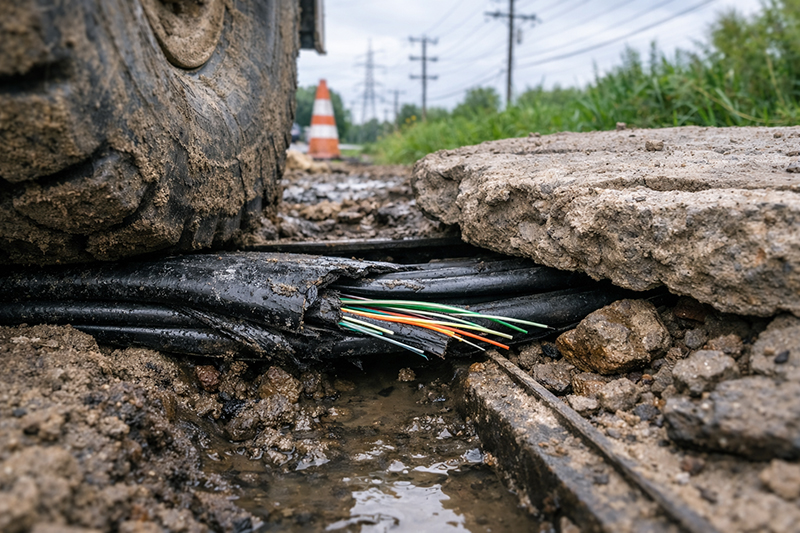
Scenario-Based Pain Point Analysis & Solution Matrix
The first step is a clear-eyed assessment of the primary threats in each deployment environment.
| Deployment Scenario | Primary Environmental Threats | Key Cable Performance Requirements | Recommended Cable Construction (Stanford Optics Portfolio) |
|---|---|---|---|
| Duct Installation | Crushing load, twisting (during pull), water ingress (in flooded ducts), abrasion against conduit. | High crush resistance, excellent tensile strength, low friction coefficient, water resistance. | Non-Armored Duct Cable: Central strength member (CSM), layers of flexible fibers, a water-swellable tape barrier, and a smooth, high-density polyethylene (HDPE) jacket optimized for pulling. |
| Direct Burial | Ground pressure, rodent/insect attack, moisture/hydrolysis, temperature fluctuations, potential chemical exposure. | Extreme crush/impact resistance, rodent repellence, superior water blocking, long-term chemical stability. | Armored Direct Burial Cable: Builds on duct cable core but adds a corrugated steel tape (CST) or interlocking steel armor under the outer HDPE jacket. Rodent-resistant jacket compounds are available. |
| Aerial Installation | Wind-induced vibration & sway, UV radiation, ice/rain loading, temperature extremes, lightning (induced voltages). | High tensile strength, excellent UV resistance, low weight, all-dielectric design (for most spans), resistance to flex fatigue. | ADSS (All-Dielectric Self-Supporting) Cable: Integrated aramid yarn or glass epoxy rod strength members within a UV-resistant black HDPE or medium-density polyethylene (MDPE) jacket. Designed for specific span lengths and wind/ice zones. |
The Lifecycle Cost Equation: Initial Price vs. Long-Term Value
The cheapest cable per kilometer can become the most expensive asset over a 25-year network lifespan. The Total Cost of Ownership (TCO) framework is essential for rational decision-making.

- Initial Material Cost: This is the visible cost of the cable itself. Armored cables cost more than non-armored; ADSS has a premium over simple lashed cable.
- Installation & Deployment Cost: A lighter, more flexible cable with a low friction coefficient reduces crew hours and the risk of installation damage (e.g., fiber strain). Clear, permanent fiber identification (chromatic coding) speeds up splicing and reduces errors.
- Maintenance & Failure Cost: This is where the right choice pays dividends. A rodent-damaged direct burial cable or a UV-degraded aerial cable requires expensive emergency repairs, service outages, and truck rolls. A cable engineered for the environment dramatically reduces mean time between failures (MTBF).
- Operational Life: A durable cable that meets or exceeds industry standards (ITU-T G.657.A1 for bend-insensitive fiber, IEC 60794 for cable performance) ensures the network can support future upgrades without needing premature cable replacement.
Decision Rule: Invest in higher-specification construction (e.g., armor, superior jacketing) where the environmental threat is high. The incremental upfront cost is almost always justified by the avoidance of a single future failure.
Deployment Efficiency: Features That Speed Up the Build
Time is money in a roll-out project. Choosing cables with installer-friendly features accelerates deployment and reduces labor costs.
- Low Bending Radius: Cables utilizing Bend-Insensitive Fibers (ITU-T G.657.A1/2) allow tighter turns around corners or in handholes without signal loss, offering greater routing flexibility and reducing splice point requirements.
- Ripcord & Easy Stripping: A properly integrated ripcord and jacket designed for clean, easy stripping save crucial minutes at every splicing point.
- Superior Chromatic Coding: Fiercely distinct, non-fading colors for fibers and buffer tubes under all lighting conditions prevent misidentification, a common source of splicing errors and troubleshooting delays.
- Optimized Cable Diameter & Weight: Engineers at Stanford Optics balance fiber count, protection, and strength to create cables that are as slim and light as possible without compromising performance, directly reducing pulling tension and fatigue.
Conclusion: Strategic Selection for a Decades-Long Asset
FTTH network infrastructure is a long-term capital investment. The selection of outdoor cable is a critical engineering decision that balances physics, chemistry, environmental science, and economics. By moving beyond a simplistic price-per-meter comparison and adopting a scenario-driven, lifecycle-cost approach, network operators can build networks that are not only faster to deploy but also significantly more reliable and cheaper to maintain over their entire operational life.
At Stanford Optics, we engineer our FTTH outdoor cable portfolio with this precise philosophy. Our products are designed to provide clear solutions to the specific challenges of duct, direct burial, and aerial environments, giving you the confidence that your physical network layer is built to last.
Ready to specify the right cable for your next FTTH project segment?
Get our comprehensive, scenario-based checklist to guide your planning, procurement, and installation discussions. Ensure no critical question is overlooked before your next cable order. Contact Stanford Optics for your region-specific requirements.