Why Should You Buy Fiber Optic Cables in Bulk?
Introduction
In our busy and competitive market, fast data transfer and strong network connections are very important. Many businesses find that keeping up with higher data needs and remote work challenges means updating their networks. Fiber optic cables offer very high performance and strong reliability. Buying these cables in bulk is a smart step that can bring many benefits.
Understanding Fiber Optic Cable Technology
Fiber optic cables use light pulses to send information along thin strands of glass or plastic. This method lets data travel fast and reliably over long distances. The cable has three main parts. First, the core carries the light signals. Second, a surrounding cladding bounces the light back into the core to keep it on track. Finally, a protective coating helps keep the fiber safe from damage. This setup lets the cable send data swiftly and with clear signals, making it much better than traditional copper cables.
Many companies need a network that supports heavy data loads, and fiber optic cables fit that need well. They handle high bandwidth with ease. In practice, a business might use these cables for a data center or a campus network where speed and reliability are key. The simple, robust design of fiber optic cables makes them a favored choice for today's demanding network environments.
Choosing the Right Fiber Optic Cables: Single Mode versus Multi Mode
When it comes to fiber optic cables, there are two common types: single mode and multi mode. Single mode cables have a very thin core that lets light travel straight over long distances without much bending. This type is best for long-distance telecommunications or wide-area networks.
Multi mode cables have a thicker core that lets multiple light paths travel at the same time. They work well over shorter distances such as within a building or local area network. In everyday use, multi mode cables are great for data centers and office networks where high-speed data is needed at a reasonable cost. Knowing the differences between these types can help a company choose the cable best suited to its needs.
Table 1. Single Mode vs. Multimode Fiber: Key Differences
| Feature | Single Mode Fiber (SMF) | Multimode Fiber (MMF) |
|---|---|---|
| Bandwidth | Virtually unlimited, high-speed | Sufficient for short-range use |
| Distance | Up to 100 km+ | 300-550 meters |
| Cost | Higher equipment costs, lower cable costs | Lower equipment costs, higher cable costs |
| Installation | Complex, requires precision | Easier and faster |
| Signal Integrity | Minimal loss and dispersion | Higher loss and dispersion |
| Best Use | Long-distance, high-performance networks | Short-distance, cost-sensitive setups |
Advantages of Bulk Purchasing Fiber Optic Cables
Purchasing fiber optic cables in large quantities is not just about having more cables on hand. There are several benefits that can improve both the day-to-day operations and long-term planning of a business.
1. Cost Savings
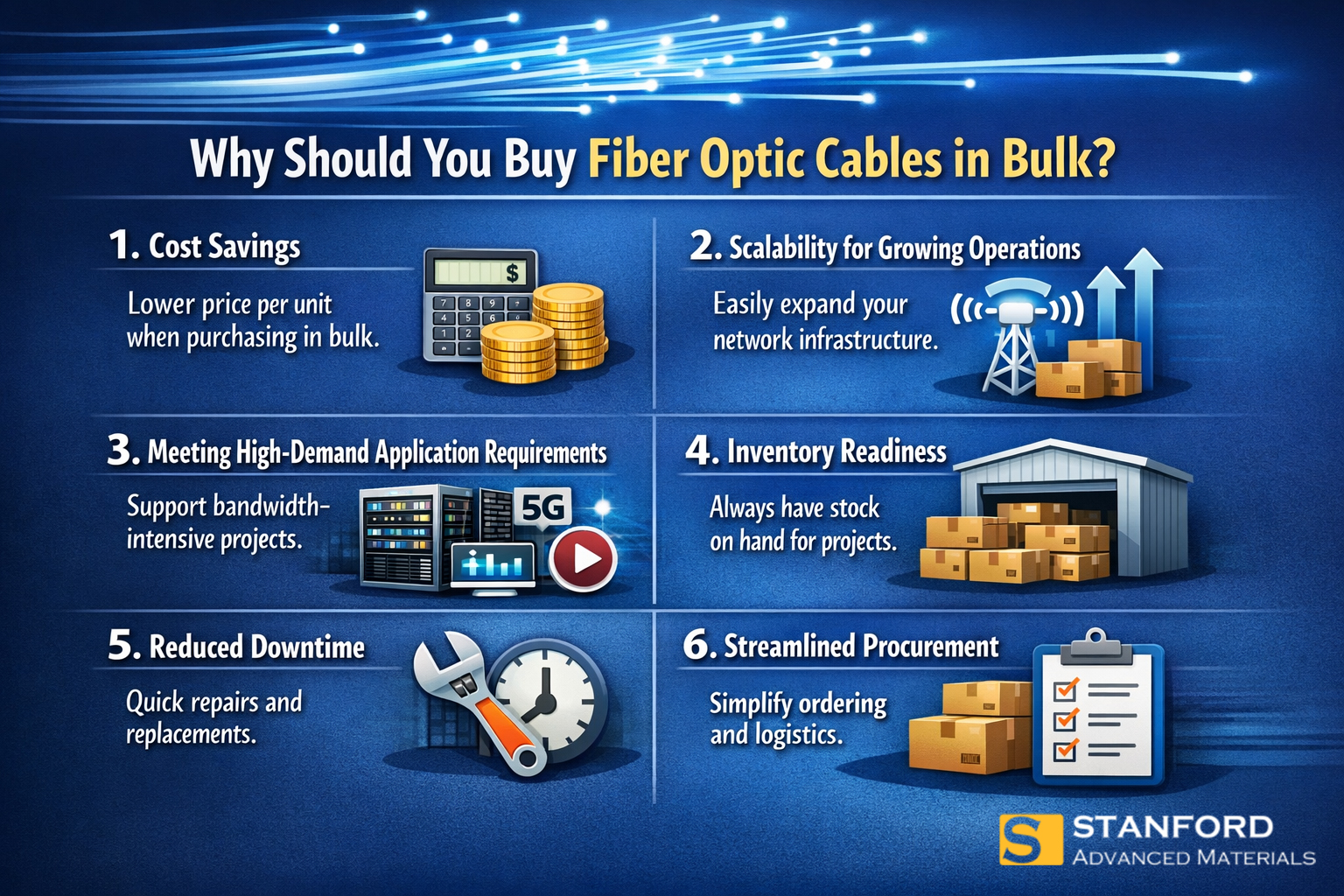
Buying in bulk usually brings lower prices per unit. Many suppliers give discounts when you order a big lot. This approach makes it possible to save money on the overall network project. Fewer orders mean less administrative work, which saves time and reduces mistakes. In addition, purchasing in bulk helps protect your budget from sudden price hikes due to market changes. This reliability makes it easier to plan for future network upgrades without unexpected costs.
2. Scalability for Growing Operations
Many businesses grow quickly and need to expand their networks without delay. Having a large supply of fiber optic cables means that additional installations or repairs can be done swiftly. This approach prevents delays that might occur while waiting for new supplies. For example, if a company opens a new branch office or needs to upgrade its data center, a ready stock of cables ensures that the network can be expanded immediately. This efficient response helps keep operations running smoothly and meets customer expectations.
3. Meeting High-Demand Application Requirements
Today's work environments often include heavy data applications such as real-time video meetings, cloud services, and large file transfers. A solid and fast connection is essential. Bulk purchasing ensures that a company always has enough fiber optic cables to maintain a strong and quick network. This is particularly important for mission-critical applications where even a short pause in service can lead to losses. By keeping a large inventory, businesses can avoid any gap in connectivity and support continuous, smooth operations.
4. Inventory Readiness
One of the key benefits of buying in bulk is having a ready stock of essential materials. With sufficient inventory, a business is always prepared for unexpected events, like damaged cables or sudden increase in service demand. Being well-stocked makes it easier to fix issues promptly. This readiness not only improves repair times but also gives engineers and network administrators peace of mind. With a robust inventory, companies can handle emergencies without a hitch.
5. Reduced Downtime
Network downtime can be very costly in today's fast-paced business world. When there are enough fiber optic cables available, repairs are done quickly and smoothly. Quick access to spare cables means that when something goes wrong—whether due to environmental causes or technical problems—the downtime is kept to a bare minimum. This fast response helps protect not just internal productivity but also customer satisfaction, ensuring that the business maintains its good reputation.
6. Streamlined Procurement
Ordering fiber optic cables in bulk simplifies the purchasing process. Instead of placing multiple small orders, a business can make fewer, larger orders. This approach reduces the time spent managing orders and dealing with multiple vendors. In a streamlined procurement process, fewer administrative tasks mean more time is available to focus on core business activities. The resulting stable supply chain helps companies plan for future network needs with confidence.
Conclusion
Investing in fiber optic cables in bulk is a wise move for businesses that value speed, efficiency, and reliability. The benefits include significant cost savings, the ability to scale quickly, and a strong safety net in the form of ready inventory. By reducing the risk of downtime and streamlining procurement processes, companies can focus more on growth and less on day-to-day network management. For anyone looking to secure quality fiber optic cables for a robust network infrastructure, a trusted supplier is key. In this regard, Stanford Optics stands ready to supply high-quality fiber optic cables and related accessories. With their commitment to excellent service and competitive pricing, Stanford Optics is a dependable partner for all your network needs.