Coaxial Cable vs. Ethernet Cable: A Practical Guide to Choosing the Right Connection
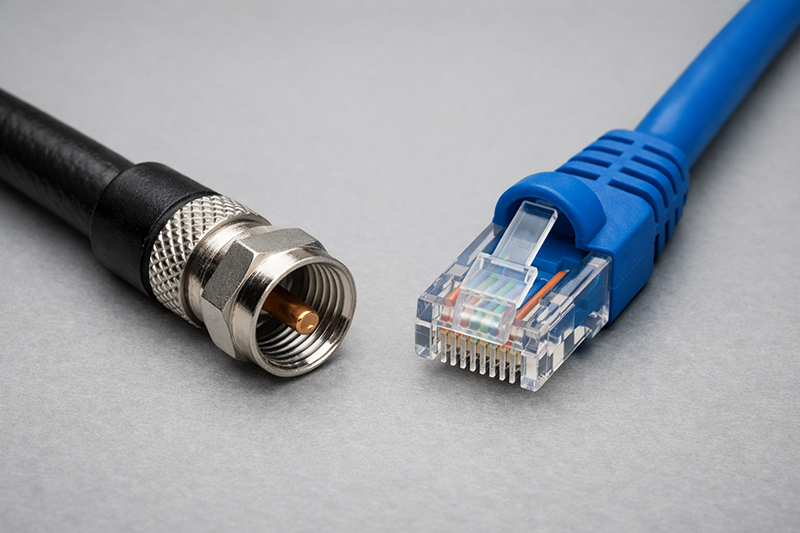
If you've ever stared at the back of a TV or computer and wondered why some cables screw on while others snap in, you're not alone. Coaxial cable and Ethernet cable look nothing alike, yet people often mix up what each one actually does.
At Stanford Optics, we supply both types—coaxial cable for video and broadband applications, plus twisted-pair Ethernet cable for networking. When customers ask "which one should I buy?", the answer almost always starts with the same question: "What are you trying to connect?"
Coaxial Cable: Built Around a Single Axis
Coaxial cable gets its name from its geometry. "Coaxial" means "shares a common axis." In everyday language: both conductors are centered around the same imaginary line running down the middle of the cable.
The basic construction:
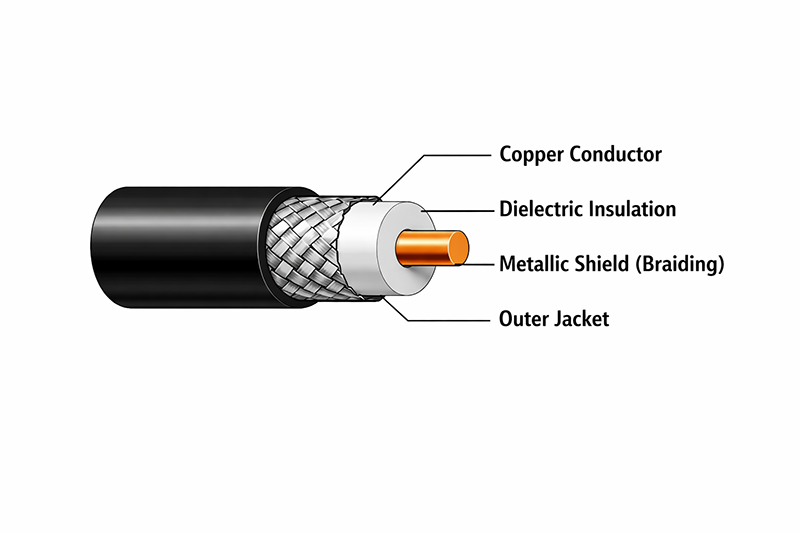
- A center conductor (solid copper or copper-clad steel) carries the signal
- A layer of insulation called the dielectric surrounds the center conductor
- One or more shielding layers (foil and/or braid) wrap around the dielectric
- A plastic jacket protects everything
The center conductor and the shield share the same axis—hence "coaxial." This design keeps the signal from leaking out and blocks outside interference from getting in.
Shielding options:
Manufacturers offer different levels of shielding depending on the installation environment. Basic shielding works fine for most residential settings. Heavier shielding—with additional foil and braid layers—is better for areas with high electromagnetic interference, like near power lines or broadcast towers, or for outdoor runs where lightning static is a concern.
Heavier-shielded cable costs a bit more and is thicker, which makes it harder to terminate. But if you're running cable in challenging environments, the extra protection is worth it.
What Coaxial Cable Is Used For
Coaxial cable has been around since the early 20th century. You've probably screwed it into the back of a television or cable modem. Common applications include:
- Cable television and HDTV
- Satellite dish connections
- Broadband Internet (from cable providers)
- Analog security cameras
- Radio antenna feeds
- Closed-circuit TV systems
A bit of history: In the 1980s, some office networks actually used coaxial cable for Ethernet. The early Ethernet standards ran at 10 Mbps over coax, using those chunky black cables with twist-lock connectors.
That changed in 1990 with the introduction of twisted-pair Ethernet. By the mid-90s, coax for networking was essentially dead—except as the pipe bringing cable TV and dial-up Internet into people's homes.
Today, coax still handles cable Internet and TV just fine. But for moving data around inside a building, Ethernet cable took over decades ago.
Ethernet Cable: Four Twisted Pairs, No Shared Axis
Ethernet cable—technically called "balanced twisted pair cable"—works on a completely different principle. Instead of one conductor carrying a signal and another acting as shield, Ethernet cable uses four pairs of copper wires. Each pair is twisted together, and each pair twists at a different rate.
Why the twisting matters:
When two wires run parallel, they act like small antennas—picking up interference from nearby electronics and radiating signal they shouldn't. Twist them together, and the interference mostly cancels out. Twist each pair at a different rate, and the pairs barely interfere with each other.
It's an elegant solution that's been refined over three decades. The result is a cable that can carry data at speeds coax never dreamed of.
Performance categories:
The industry uses "Category" ratings to specify performance levels:
- Basic Category: Handles everyday networking needs for most homes
- Mid-range Category: Better interference protection, supports higher speeds over short distances
- Advanced Category: Full high-speed performance at longer distances, improved shielding
- Data Center Category: Very high speeds for specialized applications
To put this in perspective: even the most basic modern Ethernet cable is hundreds of times faster than the old coax networks for local data transfer.
What Ethernet Cable Is Used For
Pretty much everything involving data these days:
- Connecting computers, printers, and servers in a local network
- Power over Ethernet (PoE): One cable carries both data and electricity for security cameras, WiFi access points, and LED lighting
- VoIP phones
- Video transmission over twisted pair for conference rooms and digital signage
- Smart home devices that need reliable wired connections
If it plugs into a rectangular plastic connector that clicks, it's Ethernet cable.
Quick Comparison: Coaxial vs. Ethernet
| Feature | Coaxial Cable | Ethernet Cable |
|---|---|---|
| Conductors | One center conductor + shield | Four twisted pairs (eight wires) |
| Connector Type | Screw-on or twist-lock | Snap-in (RJ45 style) |
| Typical Speed | Varies by application; moderate for broadband, slower for local networking | Fast to very fast, depending on category |
| Interference Protection | Shield blocks external noise | Twisted pairs cancel interference |
| Primary Use | TV, satellite, cable modem, antenna | Local networks, PoE, VoIP, video |
| Maximum Distance | Hundreds of feet (signal degrades) | 100 meters for standard networking |
| Power Delivery | No (requires separate power) | Yes, with PoE |
Which One Should You Use?
The answer depends entirely on what you're connecting.
Choose coaxial cable if:
- You're hooking up a TV or cable box
- Your Internet comes from a cable provider and the modem is near the wall jack
- You're installing a satellite dish
- You need to run analog video for an older security camera system
- You're setting up an over-the-air TV antenna
Choose Ethernet cable if:
- You're connecting computers, printers, or game consoles
- You're installing WiFi access points
- You need to power cameras or other devices over the same cable
- You want the fastest possible local network speeds
- You're setting up VoIP phone systems
The in-between case: Some homes use special adapters to send Ethernet signals through existing coaxial cable. It works, and Stanford Optics supplies compatible components. But running dedicated Ethernet cable is simpler and faster if you have access to the walls.
Frequently Asked Questions
Q: Is coaxial cable faster than Ethernet cable?
For local networking? No. Modern Ethernet is much faster for moving data between devices inside a building. For Internet coming into your house, cable providers can push very high speeds over modern coaxial systems. So coaxial isn't "slow"—it's just optimized for a different job.
Q: Do I need coaxial cable for Internet?
If your Internet comes from a cable company, yes—the signal comes in over coax to your modem. From the modem to your devices, you use Ethernet. Stanford Optics carries both, along with the connectors and tools to terminate them.
Q: Are all coaxial cables the same?
No. They vary in thickness, shielding quality, and materials. Thicker cables with better shielding carry signals farther and resist interference better. For television and Internet, use the better-grade stuff. For very short runs or low-frequency applications, lighter-duty cable may suffice.
Q: Can I use Ethernet cable for TV?
Not directly. But you can use extenders that send video signals through Ethernet cable. Stanford Optics offers these solutions for conference rooms and digital signage.
Q: How does coaxial compare to fiber optic cable?
Coax uses electricity over copper; fiber uses light over glass. Fiber goes farther, faster, and ignores electrical interference completely. But coax is already installed in millions of homes and businesses, so it's not going away anytime soon.
Q: Can I run Ethernet and coax in the same wall?
Yes. Just keep them a few inches apart to avoid interference, especially if the coax is carrying high-power signals.
Final Thoughts
I once watched a colleague spend ten minutes trying to snap an Ethernet connector onto a coaxial wall plate. Wrong cable, wrong connector, wrong everything. He just saw "cable" and assumed they were interchangeable.
They're not. But that's fine—they're not meant to be.
Coaxial cable brings television and Internet into your building. Ethernet cable moves data around inside it. Most homes and businesses need both, just for different jobs. And thanks to the engineers who figured out how to twist wires just right, we get to enjoy speeds that would have seemed impossible back when the first web browser appeared.
At Stanford Optics, we supply both types—along with the connectors, tools, and technical support to make sure you're using the right one. If you're not sure what your project needs, send us an email. We promise not to laugh at your connector confusion. (We've all been there.)