
Top 6 Types of Fluorescent Powders: Performance Comparison & Selection Tips from Stanford Optics
1. Introduction
You know fluorescent powders (phosphors) are critical for converting UV or blue light into visible light in LEDs, displays, and security inks. But with so many types—organic, inorganic, YAG, nitride, quantum dots—how do you choose the one that balances brightness, thermal stability, cost, and your specific application requirements without wasting weeks on trial and error?
This guide cuts through the theory. Drawing from Stanford Optics' experience supplying materials to hundreds of R&D and production projects, we focus on what actually matters for your decision:
- Which fluorescent powder type delivers the best thermal performance for high-power LEDs?
- When should you choose nitride over YAG, or quantum dots over traditional phosphors?
- How do you verify a powder's quality before scaling to production?
Below, we break down 6 major types of fluorescent powders by their real-world performance, limitations, and best-fit applications. And where applicable, we point you to specific Stanford Optics product series that have been proven in the field.
Let's get straight to the point.
2. Types of Fluorescent Powders
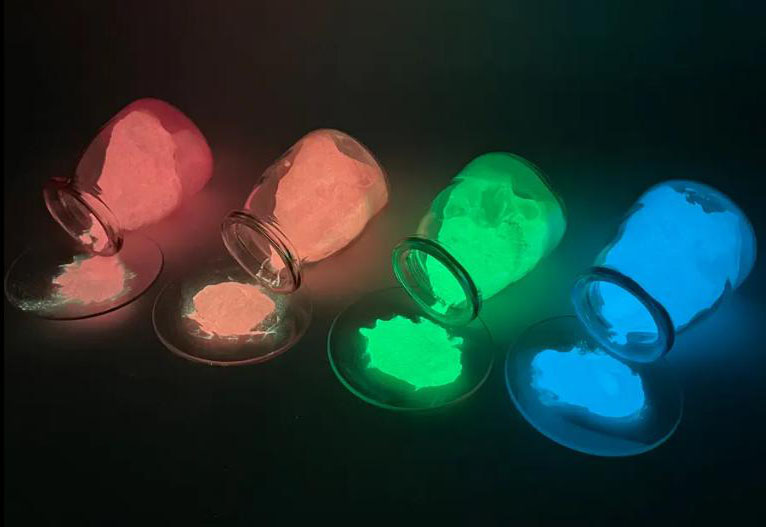
Fluorescent powders are classified into several categories based on their chemical composition and structural characteristics. The primary types include organic fluorescent powders, inorganic fluorescent powders, oxide fluorescent powders, nitride fluorescent powders, semiconductor quantum dots, and organic small molecule and polymer fluorescent powders.
2.1. Organic Fluorescent Powders
Organic fluorescent powders are made from organic molecules or polymers. They offer high color purity and tunable emission wavelengths, making them ideal for OLED displays and flexible screens. Their main limitation is lower thermal and chemical stability compared to inorganic options. You'll see them used in OLEDs, flexible displays, and high-resolution screens where color accuracy is critical.
2.2. Inorganic Fluorescent Powders
Inorganic fluorescent powders are derived from metal oxides, sulfides, and halides. They excel in thermal and chemical stability, with long operational lifespans even under harsh conditions. The trade-off is less flexibility. Common applications include LED lighting, display backlighting, and security features.
2.3. Oxide Fluorescent Powders
Oxide powders, led by Yttrium Aluminum Garnet (YAG) and specifically Cerium-doped YAG (YAG:Ce), are the industry standard for white LEDs. They deliver high light conversion efficiency, good thermal stability, and excellent color rendering. They are mature, reliable, and cost-effective. You'll find them in white LEDs, automotive headlights, general lighting, and display backlighting.
2.4. Nitride Fluorescent Powders
Nitride powders, such as GaN doped with rare earth elements, excel in high-power applications. They withstand junction temperatures above 200°C while maintaining high quantum efficiency. They cost more than oxide alternatives but offer narrow emission peaks for precise color control. These are the go-to choices for high-power UV LEDs, solid-state lighting, and advanced display systems.
2.5. Semiconductor Quantum Dots
Quantum dots are nanocrystals whose emission color changes with particle size. CdSe dots offer high tunability (520-650nm) and brightness but contain toxic cadmium. InP dots are non-toxic with comparable performance, and costs have dropped significantly in recent years. They are widely used in QLED displays, biomedical imaging, and color-tunable lighting.
2.6. Organic Small Molecule and Polymer Fluorescent Powders
Organic small molecule powders offer high luminescence efficiency and good color purity, and they can be processed from solutions for printing and coating. Polymer powders embed fluorescent molecules in a polymer matrix, adding flexibility and mechanical strength. Both retain brightness even after thousands of bending cycles. The trade-off is lower brightness compared to inorganic types. They work well for OLED displays, wearable electronics, flexible signage, and stretchable light sources.
2.7 Quick Comparison: Which Fluorescent Powder Should You Choose?
Not sure where to start? Use this table to narrow down your options based on your primary application need.
| If your priority is... | Best type to consider | Key advantage |
|---|---|---|
| Highest thermal stability for high-power LEDs | Nitride | Withstands >200°C |
| Best color purity for OLED/flexible displays | Organic | Tunable 550-650nm |
| Industry-standard white LEDs with low cost | Oxide (YAG:Ce) | Mature, reliable, 2-20 µm particle size |
| Non-toxic option for displays/biomedical | InP Quantum Dots | Cadmium-free, 520-650nm |
| Longest lifetime for general lighting | Inorganic | <5% decay at 5000h |
| Flexibility for wearable devices | Polymer | >90% brightness after 10,000 bends |
Need help deciding? [Contact us for a free consultation]
3. Application Areas of Fluorescent Powders
Fluorescent powders find extensive applications across various industries due to their unique luminescent properties. The primary application areas include the LED industry, anti-counterfeit ink applications, and several other fields such as lighting, art, security, and entertainment.
3.1. LED Industry
The LED industry is one of the largest users of fluorescent powders. LEDs rely on phosphors to convert electrical energy into visible light with high efficiency.
In white LED manufacturing, a blue or UV LED chip is combined with a fluorescent powder to produce white light. Different phosphor materials allow for color temperature control from warm to cool white.
For display backlighting, fluorescent powders are used in LCD backlights and QLED displays to enhance brightness and color accuracy.
In high-power applications such as automotive headlights, industrial lighting, and street lights, phosphors must withstand significant heat while maintaining consistent light output.
3.2. Anti-Counterfeit Ink Applications
Fluorescent powders play a crucial role in security and anti-counterfeiting. Their unique luminescent properties make them ideal for embedding invisible markers in high-value products and documents.
In secure printing, they are used in currency, passports, and driver's licenses to add hidden features verifiable under UV light. For product authentication, fluorescent powders are incorporated into packaging labels, barcodes, and QR codes to prevent counterfeiting. They also appear in contracts, legal documents, and educational certificates to protect against forgery.

3.3. Other Application Areas
Beyond LEDs and anti-counterfeiting, fluorescent powders are used across lighting, art, security, and entertainment.
In lighting solutions, they convert UV light into visible light in fluorescent lamps and street lighting, providing energy-efficient illumination. For artistic and printing applications, they serve as vibrant pigments in specialty printing, promotional materials, and decorative prints.
In security and documentation, they are added to copy paper and high-security documents to enhance brightness and prevent forgery. And in entertainment products, they create glow-in-the-dark effects in toys, party supplies, and costume accessories.
Looking for fluorescent powders for your specific application? [Contact us] for a recommendation.
4. Conclusion
Fluorescent powders, with their diverse types and exceptional luminescent properties, are integral to numerous technological and industrial advancements. From the efficiency and precision required in the LED industry to the sophisticated security measures in anti-counterfeiting applications, fluorescent powders offer versatile solutions that meet a wide array of demands.
For those seeking high-quality fluorescent powders to advance their projects and applications, Stanford Optics offers a comprehensive selection of top-tier materials tailored to diverse needs. Whether you require organic or inorganic phosphors, semiconductor quantum dots, or specialized polymer-based fluorescent powders, Stanford Optics provides reliable and efficient solutions to meet the demands of cutting-edge technologies in lighting, display systems, security applications, and beyond. With a commitment to excellence and innovation, Stanford Optics serves as a trusted partner for researchers, engineers, and industry professionals looking to leverage the full potential of fluorescent powders. [Contact us] to discuss your project.